Drowning in customer calls and messages? How to keep up without hiring
By William Mau · June 30, 2026 · 7 minute read
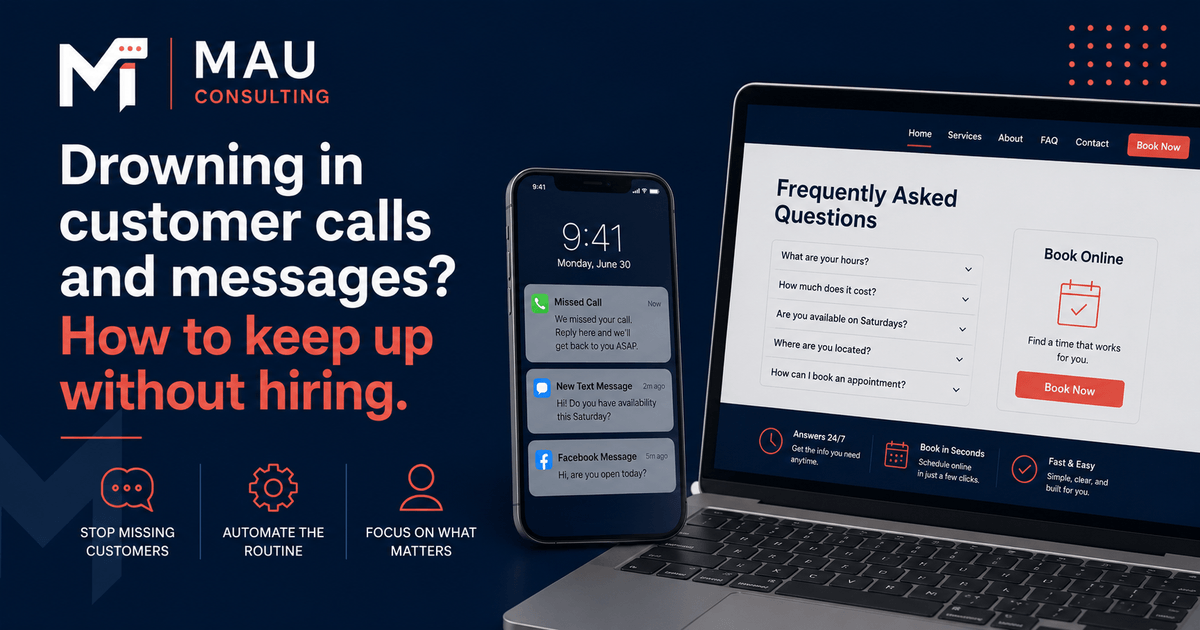
The phone rings while you are with a customer. Three texts come in. Someone messages your Facebook page asking if you are open. By the end of the day you are behind on all of it, and the thought creeps in: maybe I need to hire someone just to keep up.
Sometimes you do. But most of the time, the problem is not that you have too few people. It is that every question, big or small, lands in the same pile and feels equally urgent. The fix is not headcount. It is a simple system that sorts the routine stuff from the stuff that actually needs you, and handles a lot of it before it ever reaches your phone.
First, the good news: most of your questions are the same handful
If you wrote down every customer question for a week, you would see the same ones over and over. What are your hours? How much does it cost? Are you available Saturday? Where are you located? Can I book online?
This is not just your business. Across industries, routine questions like hours, pricing, and booking make up 60 to 80% of everything a business gets asked (ChatSpark, 2025). That is the most hopeful stat in this whole post, because it means the majority of your inbound is predictable, and predictable things can be handled once instead of one at a time.
What it is quietly costing you right now
Before the fix, it is worth being honest about the cost of the current setup, because it is bigger than a stressful day.
When you cannot get to the phone, most people do not leave a voicemail and wait. Roughly 85% of callers who reach voicemail never call back, and a large share simply call the next business on the list (Aira, 2025). The exact dollar figures floating around online come from companies selling call-answering services, so take the scariest ones with a grain of salt. But the direction is real and matches what every owner knows in their gut: a missed call is usually a lost customer, and they go to whoever picks up.
So the goal is not just "answer faster." It is to make sure the routine questions never tie up your phone in the first place, so you are free for the calls that actually need a human, and the ones worth real money.
The fix: three layers, not one big pile
Think of your incoming questions in three layers. The whole idea is to push as much as possible down to the lower layers, so very little has to reach you.
Layer 1: Let the repeat questions answer themselves
The fastest way to handle a question is to make sure it never gets asked. People actually prefer this: 73% of customers would rather solve a simple problem themselves, and 81% try to before contacting a person (Document360 / Harvard Business Review). They do not want to call you to ask your hours any more than you want to answer.
This is where a simple website earns its keep. A clear FAQ page, your hours and pricing in plain sight, and an online booking button quietly absorb the most common questions around the clock. Self-service like this has been shown to cut inbound questions by 25 to 30% (McKinsey). That is a quarter of your interruptions gone, with no one to manage. (If a Facebook page is all you have right now, here is why a website still matters.)
Layer 2: Template the routine stuff you still have to send
Some questions still come in directly, and many have the same answer every time. You do not need to retype it. Saved replies (built into most phones, email, and Facebook), a short auto-responder that sets expectations, and an automatic text-back on missed calls do the work.
That missed-call text is the single highest-value thing on this list. The moment a call goes unanswered, the customer gets an instant "Sorry we missed you, what can we help with?" message. Now instead of calling your competitor, they are in a text conversation with you, on your time. If you only do one thing from this post, do that one.
Layer 3: You handle only what truly needs you
Once Layers 1 and 2 are catching the routine questions, what reaches you is the smaller pile that actually deserves your attention: the real quote, the complicated job, the unhappy customer, the big opportunity. This is the work only you can do well, and now you have the time and focus to do it, because you are not buried in "what time do you close?" And because the system keeps running when you step away, it is exactly how you take a long weekend off without losing business.
Keep the tools dead simple
You do not need enterprise help-desk software. For a small local business, the whole system can be:
- •A website with a clear FAQ page and an online booking or contact form
- •A business number (Google Voice or similar) with automatic missed-call text-back
- •Saved reply templates for your five or ten most common questions
- •One shared inbox or place where messages land, so nothing slips through the cracks
Start with whichever gap hurts most. Missing calls? Set up text-back first. Same questions all day? Build the FAQ page. You can add the rest as you go.
When you actually should hire
None of this means never hire. It means hire for the right reason. If you bring someone on while routine questions are still flooding in, you are paying a person to do work a simple system could do for free, and you will feel just as buried a few months later.
Set up the three layers first. If the work that remains is still consistently more than you can handle, that is a real, clean signal that it is time to add a person, and now they get to spend their time on customers instead of copy-pasting your hours.
And if you are thinking about going further with an actual AI agent, the same rule applies: the ones that work are narrowly scoped, not especially smart. Here is what actually makes an AI agent work before you spend a dollar on one.
Where these numbers come from: ChatSpark customer service automation data (2025); Document360 Self-Service Statistics and Harvard Business Review (2025); McKinsey self-service research; Aira missed-call study (2025). Missed-call dollar estimates vary widely and mostly come from vendors selling answering services, so they are directional, not gospel. The patterns match what I see with local businesses here in the Capital Region.
Common questions
How many customer questions can I really handle without hiring?
What is the cheapest way to stop missing calls?
Do I need expensive software for this?
When should I actually hire someone?
Want help setting this up?
I build websites with the FAQ pages, booking, and forms that absorb the routine questions, and I help local businesses put the rest of this system in place. If you are feeling buried, I am happy to take a free look and tell you the one change that would free up the most time. No pressure either way.