I have a website. So why isn’t anyone finding it?
By William Mau · August 10, 2026 · 7 minute read
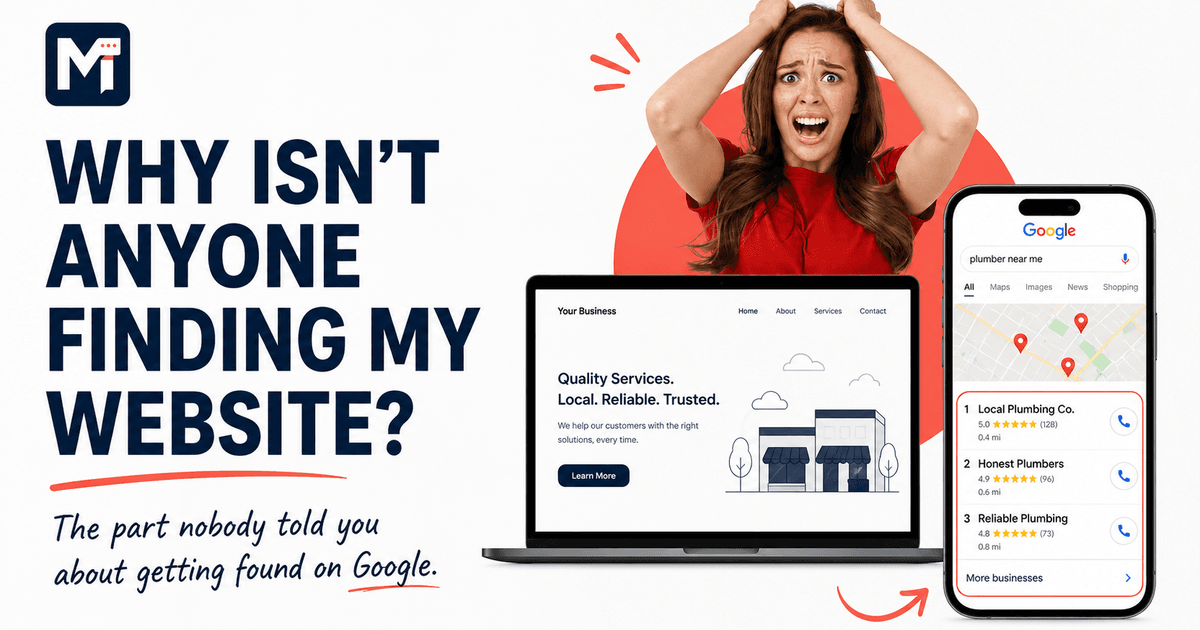
You did the thing everyone told you to do. You got a website. Maybe you paid good money for it. And then... nothing. No calls, no new customers, no sign that anyone has ever seen it. If you are quietly wondering whether you got ripped off, that is a fair question to ask.
Here is the honest answer: a website is necessary, but on its own it does almost nothing to get you found. Getting found is a separate job, and it is the part nobody tells you about when they sell you the site. The good news is that the job is learnable, most of it is free, and I can walk you through exactly what actually moves the needle.
A quick confession so you know I am not talking down to you: I went through my own version of this recently. I set up a Google Business Profile for my own business, and Google’s automated system promptly suspended it. I had to appeal, prove I was real, and wait to get reinstated. So if your online presence feels like a fight you did not sign up for, you are not behind. You are normal. Let me save you the trial and error.
First, why your website alone stays invisible
Nobody finds a local business by typing your web address. They go to Google and search for what they need. And here is what has quietly changed: Google increasingly answers the search without sending anyone to a website at all. In early 2026, about 68% of U.S. Google searches ended with no click to any website (SparkToro and Similarweb, via Search Engine Land), and Google’s new AI answers, which now appear on more than 20% of searches, cut click-through by roughly 60% when they show up.
What that means in plain terms: getting your website page to “rank” is no longer the main game. For a local business, the game is being the business Google shows inside its own results, in the little map of three businesses at the top, in the reviews, and in the AI answer. Your website supports that, but it is not the thing doing the winning.
The part nobody told you: getting found is a system, not a website
Getting found locally comes down to three things working together. Miss one and the whole thing gets quiet, which is probably what happened to you.
1. Your Google Business Profile is the single biggest lever
This is the free listing with your map pin, hours, photos, and reviews. It is the most important thing on this page by a wide margin. In the industry’s annual survey of what drives local rankings, Google Business Profile signals make up roughly 32% of what decides the map results, the single largest factor, and the number one individual signal is simply your primary business category (Whitespark, 2026). Six of the top ten ranking factors live on that profile, not on your website.
If your profile is unclaimed, half-filled, or has the wrong category, you are invisible in the exact place customers are looking. Claim it, verify it, choose the most accurate primary category, fill in every field, and add real photos. (This is the one that got me suspended and then reinstated, so if it fights you, appeal and keep going. It is worth it.)
2. Reviews decide whether you are even considered
Reviews are the second biggest ranking factor and their importance is rising (Whitespark, 2026). But they matter just as much for the human deciding whether to call you. The numbers on how people say they behave are blunt: 97% read reviews for local businesses, 68% will only use a business rated four stars or higher, and 47% will not use a business with fewer than 20 reviews (BrightLocal, 2026). Roughly 80% say they are more likely to choose a business whose owner replies to reviews.
So a great website with three old reviews loses to a plain competitor with fifty recent ones. Ask every happy customer for a Google review, make it easy with a direct link, and reply to all of them, the good and the bad. Recent reviews are both a ranking signal and the thing that wins the click.
3. Be consistent and clear everywhere
Google is trying to confirm you are a real, local business that matches the search. You help it by keeping your name, address, and phone number identical everywhere they appear: your website, Google, Facebook, Apple, anywhere you are listed. Mismatched or old information makes Google less sure about you, and less sure means less visible.
Your website has a real job here too. It should plainly say what you do and which towns you serve. Name your area (Schenectady, Albany, Saratoga, wherever you work), give each main service its own clear page, use a real headline, and make sure it loads fast on a phone. That is what lets Google connect your site to your profile and to the searches that matter.
Your website’s job changed. It didn’t disappear.
None of this means your site was a waste. Its role changed. It is now your home base, the part you own, that feeds and backs up everything else. People do not trust one source: the typical customer checks around six different places before choosing a local business (BrightLocal, 2026). They see your Google listing, then your reviews, then your site, and they need all three to agree and look legit.
There is a newer wrinkle worth knowing about, too. People are starting to ask AI for recommendations: use of tools like ChatGPT to find local businesses jumped from 6% to 45% in a single year (BrightLocal, 2026). And AI can only recommend a business it can actually read across Google, reviews, and your site. Same system, one more reason to get it right. (More on that here: are your customers asking AI instead of Google?)
So what do you actually do? Start here.
In plain order of impact, this is the whole checklist:
- 1.Claim and complete your Google Business Profile. Right category, every field, real photos. This is the biggest lever, so do it first.
- 2.Get recent Google reviews and reply to every one. Ask happy customers directly. This never stops mattering.
- 3.Make your name, address, and phone match everywhere. Website, Google, Facebook, all identical.
- 4.Make your website say what you do and where. Town names, a page per service, a clear headline.
- 5.Make sure it loads fast on a phone. Most of your visitors are on one.
Do the first two and you will usually see more than doing everything else combined. None of it requires paying Google a cent.
Where these numbers come from: Whitespark 2026 Local Search Ranking Factors survey; BrightLocal Local Consumer Review Survey (2024 and 2026); SparkToro and Similarweb zero-click study (via Search Engine Land, 2026); Seer Interactive AI Overviews click-through analysis. Ranking-factor weightings are expert-survey estimates, and consumer figures reflect what people say they do, so treat them as directional. They match what I see with local businesses here in the Capital Region.
Common questions
Why does my website only show up when I search my own business name?
Do I have to pay for Google Ads to show up?
How long until I start getting found?
I have a Facebook page and a website. Isn’t that enough?
A website that doesn’t get found isn’t finished
This is exactly why I do not treat getting found as an upsell. When I build a website, I build it to be found: Google Business Profile setup, the local SEO basics, and the review groundwork are part of the job, not a separate invoice. If your current site is quiet, I am happy to take a free look and tell you the one thing I would fix first. No pressure either way.