Your AI agent doesn’t need to be smarter. It needs to be scoped.
By William Mau · August 18, 2026 · 7 minute read
In late 2025, Salesforce cut thousands of customer-support roles and pointed to its own AI agents as the reason it needed fewer people. That story made a lot of business owners feel like they were already behind. If the giants are replacing whole teams with autonomous agents, the thinking goes, I should be racing to do the same.
Here is what that story leaves out: for every headline agent that works, plenty are quietly getting shelved. Gartner expects more than 40% of agentic AI projects to be canceled by the end of 2027. And the reason is almost never the one people assume.
The mistake everyone makes
When an AI agent project fails, people blame the model. Not smart enough. Wait for the next version. But that is rarely the real problem. The models are already good enough for most business tasks. What fails is everything around the model: how narrowly the job is scoped, how it connects to your real systems, and whether a human is watching the parts that matter.
I have built several AI agents that run in production, handling real customer support, triaging real sales leads, and reconciling real payments. The ones that work are not the smartest. They are the most narrowly scoped.
To put real numbers on it: one of these support agents handled about 76% of a 2,900-case queue last month, resolved most cases in seconds, and runs on under a dollar a month. More telling than the speed: 93% of what it closes stays closed, and under 5% ever needs a human to step in behind it. That reliability is what scoping buys you.
This isn’t just my opinion
Deloitte’s August 2026 readiness survey found only 5% of organizations consider their processes highly prepared for AI agents. The top three barriers were unified data (72%), trust and governance (70%), and integration cost (67%). Not one was model quality. Teradata’s 2026 report found 63% of tech leaders had seen no more than minimal return on their agentic AI investments so far. And in Deloitte’s broader survey, only 21% of companies had a mature way to govern agents while nearly 75% planned to deploy them within two years.
In plain terms: everyone is rushing to deploy, almost nobody is ready, and what is holding them back is organizational, not technical.
Why agents actually fail
Three things, over and over.
1. Scope creep
The most common mistake is asking an agent to do too much. “Handle customer support” is not a job you can hand an agent. It is a hundred jobs. Point a model at that and it does the easy 60% acceptably and the hard 40% badly, and the hard 40% is what creates angry customers. A large field experiment at Alibaba showed it clearly: autonomous support agents handled chats faster but were rated worse, and a human could rescue the technical failures but not the emotional ones. The lesson is not “agents do not work.” It is that agents are good at some slices of a job and bad at others, and you have to know which is which.
2. Integration
The unglamorous one. Your agent has to plug into the systems you already run: your CRM, your email, your files. That is where most of the engineering time goes, and where most of the breakage happens. In my own systems, when something goes wrong, it is almost never the model being wrong. It is two automations stepping on each other, or a file saved somewhere the agent cannot see, or a permission nobody granted. The intelligence is fine. The plumbing is where it breaks.
3. Missing oversight
An agent that can act with no human checkpoint will eventually act wrongly, confidently. The question is not whether that happens. It is whether you find out.
What actually works
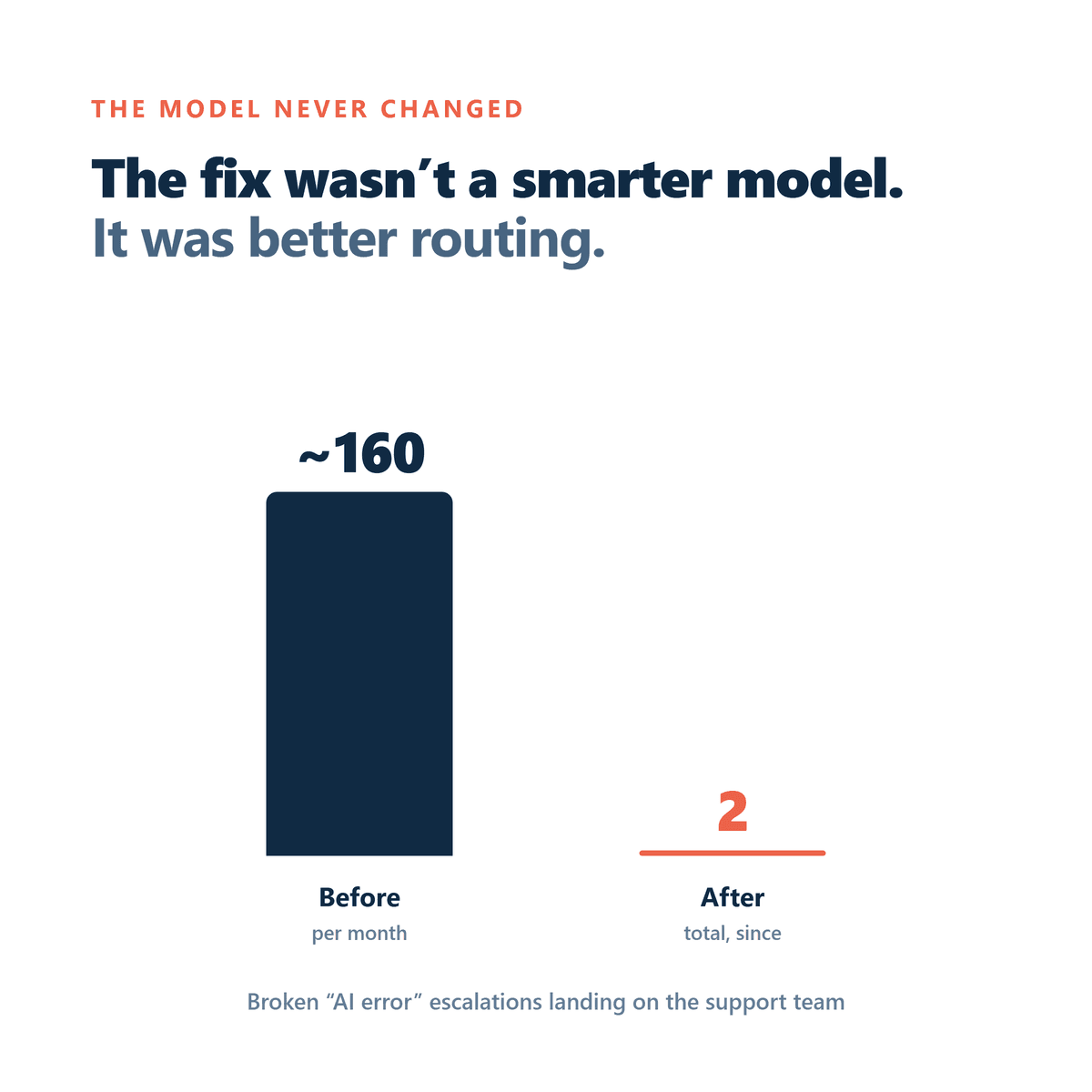
Here is the clearest example I can give you. My support agent kept choking on messages it could not cleanly read, and about 160 of them a month were landing on my team as broken “AI error” escalations. The obvious fix is a better model that fails less often. That is not what I did. I changed how those cases got routed, so instead of dumping on a human as an error, the agent now sends the customer a simple “can you give me a bit more detail?” and waits. Those 160 errors a month dropped to two. The model never got smarter. The routing got better, and that single change drove most of the agent’s jump from 70% to 76% handled on its own. That is the whole lesson in one fix.
Here is what I do to make an agent survive contact with a real business. None of it is about a smarter model.
- •Give it the smallest possible job. My support agent does not “answer the customer.” It reads an email, classifies it into one of about sixteen specific request types, and writes two short lines of personalization that drop into a reply template a human wrote. The model selects and fills. The humans wrote the words.
- •Use the cheapest model that can do the job. Most of my agents run on a small, inexpensive model, not the biggest one. That is not a compromise, it is the point. Scope the job tightly enough and a small model does it reliably and cheaply. Reaching for a bigger model is usually a sign the job is too broad, not that the model is too weak.
- •Separate reading from deciding. When a customer sends a receipt, one model reads what is visible and is explicitly told it is not deciding anything. Then plain, deterministic code applies the policy and makes the call. A model that misreads a fact cannot, on its own, take a wrong action.
- •Gate anything that matters. Issuing an access code, closing a case, marking an invoice paid, none of it happens unless the system clears a hard confidence threshold, and the consequential calls wait for a person. On my lead system, the model only runs on the ambiguous minority of leads; simple rules handle the clear majority without ever calling it.
- •Build the safety rails first. A kill switch to shut the whole thing off. A shadow mode where it runs silently and you compare its calls to reality before it touches anything. An audit trail so every action leaves a comment explaining itself. I launched more than one of these agents deliberately turned off, watched it in the dark for weeks, and only then let it act.
And if you run a small business where even that is more than you need right now, the same instinct, catch the routine work and keep a human on the judgment, is exactly how you handle more customers without hiring in the first place. You rarely need an agent as sophisticated as you think.
The real question
None of that fits in a keynote about autonomous agents replacing your workforce. But it is the difference between an agent that quietly does real work for years and one that becomes a cautionary tale in someone’s board deck.
So if you are wondering whether the technology is finally good enough, you are asking the wrong question. It is good enough. The real question is whether you can carve out a job narrow enough, and wire in enough oversight, that a not-especially-smart model can do it reliably.
Your agent does not need to be smarter. It needs to be scoped.
Where these numbers come from: Gartner (2025); Deloitte’s agentic-AI readiness survey and State of AI report (2026); Teradata’s 2026 Agentic AI report; and a 2026 field experiment on autonomous customer-service agents. The examples from my own work are generalized from real systems I have built and run in production.
Common questions
Why do most AI agent projects fail?
Do I need the most advanced AI model for my business?
What does it mean to "scope" an AI agent?
Should AI agents run fully autonomously?
Thinking about AI for your business?
The hard part is rarely the model. It is figuring out the one job worth automating, how it fits the way your business already runs, and where a human still needs to be. That is the kind of thing I help with. Happy to talk it through, no pressure either way.